
 تمت إعادة ضبط إعدادات الوصول.

About Quality Infrastructure
Quality Infrastructure is the system of public and private organizations, along with rules, policies, and practices, that help ensure the quality, safety, and environmental soundness of products, services, and processes
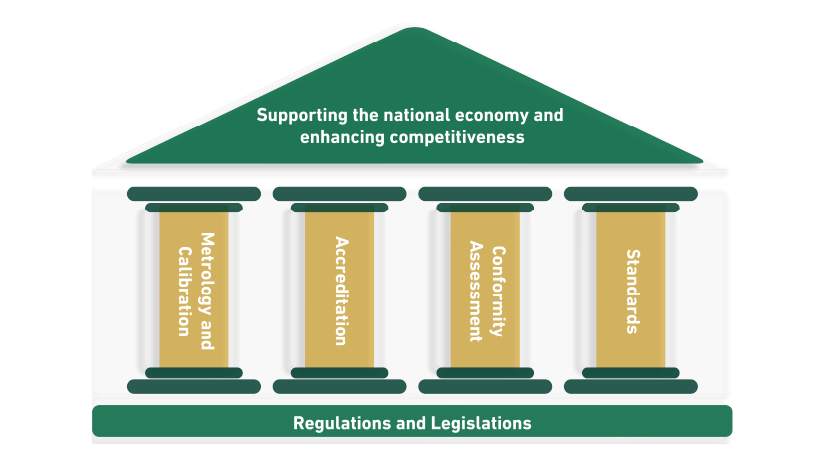

Standardization
They are documentation for the establishment and development of standards, specifications, requirements, and detailed characteristics of products, services, or processes and associated production methods, with which compliance is optional."

Conformity Assessment
It is verification of the conformity of products, services or processes to standardizations, technical regulations and pre-determined specifications.
Accreditation
A third-party attestation stating that a specific body providing conformity assessment services in a specific field is formally qualified to perform specific conformity assessment tasks after fulfilling all requirements set out in international guides to ensure the sustainability of its competence. This includes, but is not limited to, the accreditation of testing, calibration and medical laboratories, inspection bodies, certification bodies, and other relevant entities

Metrology
A set of Metrology laboratories performing measurement operations carried out according to international standards and practices assigned to achieve the national metrological traceability of measurement results in the Kingdom to the units of the International System (SI). Such system determines the CMC of the measuring instruments and their suitability for the purpose for which they are used, and the extent of their compliance with the International System of Units according to specific international standards.
The Importance of Accreditation
- Increases international acceptance for imports and exports and promotes trade exchange.
- Safeguards impartiality and prevents conflicts of interest.
- Enhances public confidence levels for consumers in the goods and services available in the market.
- Gives confidence in reports, certificates, and conformity data.
- Supports the quality of results by ensuring their traceability, comparability, validity, and equivalence.
- Reduces production defects and the probability of product failure.
The Role of Accreditation
The role of accreditation includes evaluating the competence of conformity assessment bodies, their impartiality, and their compliance with nationally and internationally recognized standards and scopes of accreditation. It also ensures that the best international standards and references are applied, guaranteeing the implementation of national and international standards in terms of competence, impartiality, and independence.
Accreditation Principles

Competence
The technical expertise and skills of personnel within an accredited or applicant conformity assessment body are verified by qualified assessors who possess relevant specialized experience and knowledge.

Impartiality
Accredited conformity assessment bodies must ensure the absence of conflict of interest and manage any existing risks to safeguard impartiality in the services provided.

Independence
Accredited conformity assessment bodies must demonstrate independence from the organizations to which they provide their services.
Benefits of Accreditation

Promoting International Trade
The existence of nationally and internationally recognized accreditation bodies contributes to increasing the level of trade exchange and the flow of goods and products to and from global markets

Risk Reduction
Protects public health and safety by mitigating risks through collaboration with reliable laboratories and inspection bodies that hold accredited certificates from national accreditation bodies.
Legislation Enforcement
Supports the implementation of national legislations and provides the 'Conformity Mark' to confirm compliance with standards and requirements.

Cost Reduction
The presence of national accreditation centers helps reduce the need for government entities to employ technical experts and assessors, thereby minimizing redundancy and duplication in auditing processes.

Public Confidence
Collaboration with internationally recognized national accreditation bodies enhances confidence in the impartiality of public activities related to health, safety, and the environment.
Job Creation
Accreditation allows for the creation of new business opportunities and horizons, and stimulates investment in the conformity assessment sector and opening up to new markets.

Efficiency Enhancement
Precise calibration, measurement, and testing help reduce errors, improve production cost control, and contribute to innovation.
Business Facilitation
Accredited certificates help ensure compliance with standards and official regulations, meaning that companies do not need to provide additional evidence.

Export Support
International recognition of conformity assessment reports covered by accreditation enhances business expansion in foreign markets without the need for additional verification processes.
Confidence in Products and Services
Accreditation enhances consumer confidence in services and products, based on regularly evaluated and inspected by a competent and independent third party.
Consumer Protection
Enhances consumer safety through product certification, which provides confidence and credibility to the consumer as it is issued by accredited conformity assessment bodies.
Industries

Metrology and Calibration

Digital

Construction and Building Sector

Energy

Healthcare

Environmental

Food Industries

Transportation and Logistics